Transport phrases for travel: taxis, trains and the first hour after landing
Transport phrases for travel are the ones you need before you have had a coffee: the taxi queue, the ticket machine, the platform, the address said out loud. Phrazl is built so you choose transport as one of your scenarios, get the phrase set for your destination's language, and practise it out loud on a schedule that tightens as your departure date gets closer.
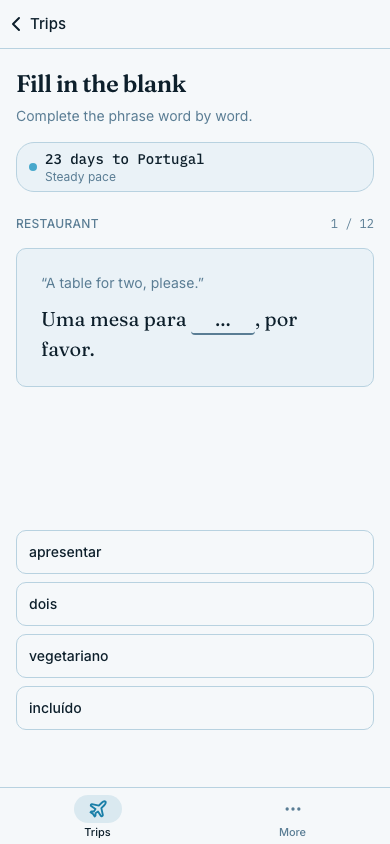
A screenshot of Phrazl, which is not open yet, showing sample data. Nothing in it is a promise: what the product does is what this page says in words.
The hour nobody rehearses
You have landed, the signage is in a script you can only half decode, and ahead of you is a taxi queue, a ticket machine with eleven buttons and a driver who will ask you something short and expect an answer. This is the first real conversation of the trip, and you are having it at your least sharp.
The job is narrow: name where you are going, understand roughly what it will cost, ask whether this is the right platform, and say stop here, please, before the meter carries you past your street. Phrazl is built for precisely that, a transport phrase set in your destination's language that you practise out loud before you fly, not a course you keep at for a year. Polite rather than impressive, and without holding a phone screen up at a driver and hoping.
Most people arriving at this are replacing something rather than starting from nothing. The complaint, in travellers' own words, tends to run: 'the phrases that Duolingo teaches are definitely not the most practical ones for travelers.' Next to it sits the other familiar line, 'I don't care at all for all this other extra gamified shit with all this XP, streaks, and whatever else.' Phrazl takes the other approach. You name the destination, you name the date, you pick transport, and you practise the phrases you will actually use until they come out of your mouth without a search.
Why transport is usually the first scenario to pick
Phrazl asks you to choose up to three scenarios from five: restaurant, transport, hotel, emergency and shopping. That cap is deliberate, because a fortnight of evenings will not carry five sets at once, and it means your first real decision is which three.
Transport tends to earn a slot for three reasons.
- It comes first. It is the conversation you have before you have adjusted to the place, in a queue, with people behind you.
- It repeats. A restaurant happens once an evening. Moving around happens every time you leave the door, and the same ten or fifteen lines keep returning.
- Pointing does not get you far. In a restaurant you can gesture at a line on a menu and recover most of the meaning. On the move, the thing you need often comes back at you as a number, a platform, a direction or a price, said quickly, and a gesture cannot answer a question.
What to pair it with depends on the trip. Transport and restaurant is the common shape for a city break, and the restaurant page covers that side. Transport and hotel suits a late arrival, where the first two conversations run back to back. Shopping is for markets, sizes and prices. The emergency set is there for the lines you hope you never say, and it carries a clear note when you select it, repeated in the terms: those phrases are for general communication practice, not a substitute for contacting local emergency services or a qualified interpreter. If you are still deciding how to spend your three slots, the survival phrases guide lays out all five situations side by side.
The destination selector covers ten places: Portugal, Spain, France, Italy, Germany, Japan, China, South Korea, Thailand and Greece. One country per language, which is worth reading literally: Spain rather than Mexico, Portugal rather than Brazil, Germany rather than Austria. The country you pick is what decides the language of your transport set, so check yours is on that list before you plan your evenings around it. There is no Dutch set yet, which means an Amsterdam tram is one conversation Phrazl cannot prepare you for today.
How the transport set gets built and practised
- Pick your destination
Setup is three steps, and this is the first one. The destination decides the language, and Phrazl covers ten of them, so the phrases you see are the ones used where you are going rather than a generic international phrasebook.
- Put in your departure date
The date is not decoration. Phrazl's spaced repetition schedule treats it as a hard deadline and compresses the intervals as it approaches, so reviews come back at you more often the closer you get to the airport. If the flight moves, the date can be changed later on that trip's edit screen and the schedule recalculates from the new deadline.
- Choose transport, and up to two more scenarios
The third setup step is the scenario selector: up to three from restaurant, transport, hotel, emergency and shopping. Pick transport and you get the transport set for your destination's language, nothing diluted by vocabulary you will never use.
- Work through the set in the order it matters
The phrase sets are curated per language and scenario and ordered by trip relevance, so the lines you are most likely to need arrive first. A trip pack opens 50 phrases per scenario, which for transport alone is 50 lines, and up to 150 across three.
- Say it, hear it, then read it again
Three modes on the same phrases. Flashcard for recall. Listen and repeat, where the phrase plays and you say it back out loud, at speed or slowed down to copy, with a written pronunciation guide next to it. Fill in the blank puts a gap in the line and offers you the missing word among a few options.
- Read coverage rather than congratulation
One progress bar, labelled as curriculum coverage completed. No streaks, no XP and nothing that pretends to score your future conversations. Read it as a fraction of the phrases you can currently reach, which means the figure falls the moment you buy: ten of the free 20 shows as half, and those same ten against a 150-phrase pack show as seven per cent, with no line on screen acknowledging the drop. Same work done, bigger denominator.
The three modes, and what each one is for
| Mode | What happens | When it earns its keep |
|---|---|---|
| Flashcard | The prompt comes up, you produce the phrase, then you grade yourself | Early on, when you are still finding the words at all |
| Listen and repeat | The phrase plays, at speed or slowed, and you say it back out loud | Pronunciation and rhythm, for a line you will deliver standing up |
| Fill in the blank | The phrase appears with a gap, and you pick the missing word from a short list | One close read of a line you half know, with the word in front of you |
What the audio is, and what the modes cannot do
Worth saying plainly, because it is the question anyone who has heard a robotic app voice will ask next. The audio on every phrase, in the free preview and in a paid trip pack, is a synthesised voice rather than a recording of a native speaker. The app labels it that way where you hear it and again at checkout, so nobody buys expecting otherwise. Recordings by native speakers are not part of what a trip pack gives you today.
What a synthesised voice is good for is the shape of the line: the word order, where the stress falls, which syllables you are swallowing that you should not be. That is most of what stands between you and being understood when you say 'Pare aqui, por favor' to a driver in Lisbon. What it will not give you is a Lisbon accent, or the speed a real driver answers at. Each phrase also carries a written pronunciation guide, which is there for the sounds a machine voice glosses over, and for the phones whose browser refuses the clip file outright and leaves the speaker button doing nothing.
Three honest limits on fill in the blank
- It makes a gap by removing a word, which depends on spaces between words. For Japanese, Chinese and Thai it cannot do that, so on those three destinations it falls back to choosing the whole phrase rather than completing it word by word.
- Where it does blank a word, the correct option lands either first or last in the list, and most often last, so the mode is easier than it looks.
- On a very short review queue it can run out of other words to offer and hand you the answer on its own, which flatters your coverage figure without teaching you anything.
One more thing to expect: pick wrong and the screen shows the phrase with the correct word marked in red, rather than the word you chose. Read it as the right answer rather than a record of your mistake. On any destination, treat flashcard and listen and repeat as the two modes doing the work.
If the flight moves, or the trip does
Every review interval is calculated from one field, so the departure date is the thing most worth getting right and the thing most likely to change. Open that trip's edit screen, change the date, and the compression recalculates against the new deadline. Mistype it on setup and the fix is the same screen rather than a second trip.
Two things to know before you edit anything beyond the date. Changing the destination on an existing trip switches the language, and your review history is attached to the phrases of the old one, so your coverage figure resets to zero even though the screen tells you progress stays where it is. If you are swapping country rather than date, treat it as a new trip. On the free preview you hold one trip set up at a time, so changing your mind there means re-pointing the trip you have.
Deletion is deliberately asymmetric. A trip with no pack bought against it can be deleted from its edit screen along with its review history. A trip you have paid for stays on your account, because deleting it would take the unlock with it. Purchase and refund problems are raised from the support form on the account screen, and deleting the whole account removes the account, trips, review history, purchase records and support requests together.
What this gives a traveller with a date in the calendar
A set ordered by trip relevance
The transport phrases are ranked by how likely you are to need them, so a short week of practice still lands on the lines that matter in a taxi queue.
Out loud from the first session
Listen and repeat exists because reading a phrase and saying it are different skills, and only one of them helps when a driver is waiting for an answer. Play it at speed, slow it down, read the pronunciation guide, say it again.
A deadline instead of a streak
Your departure date drives the schedule, and you can change it on the trip's edit screen when the flight does. Reviews tighten as it nears, which is the opposite of an app that asks for one minute a day forever.
Scope you can finish
Up to three scenarios, chosen by you. Transport on its own is 50 phrases, a set you can genuinely cover before you fly, rather than a course you abandon in week three.
Progress stated honestly
The single bar reports curriculum coverage completed against the phrases you can currently reach, so the number falls when a purchase adds the rest of the set to the total. It is how much of the set you have worked through, not a prediction of how a conversation will go.
No subscription to cancel later
Trip packs are built as a one-time purchase through Stripe, which suits a thing you need for one fortnight in a specific country.
Ten destinations to choose from
Portugal, Spain, France, Italy, Germany, Japan, China, South Korea, Thailand and Greece, one country per language. The destination selector decides your set rather than asking you to translate your way into it.
What a transport set costs
Free preview, free
Set up a trip with destination, departure date and scenarios, and try the first 20 phrases of it. Audio on every preview phrase, spoken by a synthesised voice, plus the departure countdown and review schedule. Limit: one trip set up.
Questions
What counts as a transport phrase?
Transport is one of the five scenarios you can select during setup, alongside restaurant, hotel, emergency and shopping. It is the set for getting yourself and your bags from one place to another: taxis, trains, buses, tickets, directions and the short exchanges that come with them, in your destination's language.
How many transport phrases do I get?
The free preview opens the first 20 phrases of your trip.
Is the audio a native speaker?
No. The audio on every phrase is a synthesised voice rather than a native-speaker recording, and the app says so where you hear it and again at checkout. Native-speaker recordings are not part of what a trip pack includes. The voice gives you the word order, the stress and the rhythm of the line, and each phrase comes with a written pronunciation guide and the option to slow the playback down to copy it.
Does fill in the blank work on every language?
Not in the same way. It makes a gap by splitting the phrase on spaces, so for Japanese, Chinese and Thai it falls back to choosing the whole phrase instead. Where it does blank a word, the correct option lands first or last in the list and usually last, and on a very short queue it can offer the answer alone. Take the mode as a close second read of the line rather than a test, and let flashcard and listen and repeat carry the practice.
Can I change my departure date after I set the trip up?
Yes. The departure date can be changed on that trip's edit screen, and the review schedule recalculates against the new deadline, which matters because every interval is derived from it. Changing the destination there is different: it switches the language, and your review history belongs to the old language's phrases, so your coverage figure resets to zero. A trip with no pack against it can also be deleted from that screen, while a trip you have paid for stays on the account.
Can I choose transport without buying anything first?
Yes. Setup is three steps, destination, departure date and scenarios, and the free preview gives you the first 20 phrases of the trip you built, with audio and the review schedule, before any purchase. Phrazl is on a waitlist today, so payments are not open yet in any case.
Which destinations are available?
Ten: Portugal, Spain, France, Italy, Germany, Japan, China, South Korea, Thailand and Greece, one country per language, so Spain rather than Mexico and Portugal rather than Brazil. The full bundle covers all ten, and the destination you pick decides which set you practise. Dutch is not among them, so the Netherlands is not covered yet.
Does the departure date actually change what I practise?
It changes when you practise. The spaced repetition schedule treats your departure date as a hard deadline and compresses review intervals as it gets nearer, so the same set is spread out early and comes back more often the closer you get.